In The Gorges of the Balkans
Karl May was one of the most widely read German writers of the late nineteenth century, renowned for his adventure novels set in the “Orient” and the Balkans — regions he largely imagined before ever travelling there himself. Writing through the lens of European colonial fantasy and geopolitical exoticism, May constructed vast fictional territories populated by shifting boundaries between civilisation and barbarism, Christianity and Islam, Europe and its perceived “others.” His novels contributed to a broader European imaginary that positioned the Balkans as a volatile threshold perpetually suspended between myth, violence, and war.
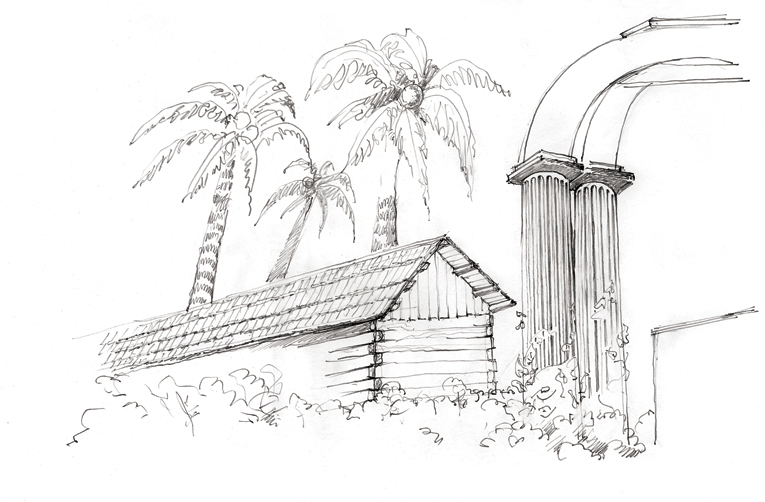
For In the Gorges, Jasmina Cibic collaborated with forensic police artist Boris Trobec, whose professional practice reconstructs faces and scenes from the testimonies of traumatised witnesses. Here, however, the logic of forensic truth is redirected toward the geopolitical fiction of a region unable to escape its historical othering: Trobec renders landscapes and architectures that do not exist, based solely on the artist’s verbal descriptions of imagined Balkan locations derived from May’s writing. Produced through a hand trained to generate evidentiary images, the drawings occupy an unstable space between document and invention, exposing how representation manufactures belief — and how territories themselves are constructed through acts of projection, narration, and visual authority.
In this displacement of forensic method into the realm of fiction, In the Gorges interrogates the unstable boundary between representation and truth, foregrounding the artist’s own implication in the production of cultural imaginaries. The authority traditionally granted to both the artist and the forensic image becomes uncertain: what appears evidentiary remains speculative, while fiction acquires the persuasive force of documentation. Through this layered collaboration, Cibic reveals how landscapes, identities, and geopolitical narratives are continually authored, mediated, and naturalised through visual representation itself.

In the Gorges (Ard), 2006/07
Pencil on paper, framed
29 cm x 42 cm
In collaboration with Boris Trobec, former police sketcher

In the Gorges (Chatar Defile), 2006/07
Charcoal on paper, framed
29 cm x 42 cm
In collaboration with Boris Trobec, former police sketcher

In the Gorges (El Hadd I), 2006/07
Pencil on paper, framed
29 cm x 42 cm
In collaboration with Boris Trobec, former police sketcher

In the Gorges (El Hadd II), 2006/07
Pencil on paper, framed
29 cm x 42 cm
In collaboration with Boris Trobec, former police sketcher

In the Gorges (Island of the Heathen I), 2006/07
Pencil on paper, framed
29 cm x 42 cm
In collaboration with Boris Trobec, former police sketcher

In the Gorges (Island of the Heathen II), 2006/07
Pencil on paper, framed
29 cm x 42 cm
In collaboration with Boris Trobec, former police sketcher

In the Gorges (Sitara I), 2006/07
Pencil on paper, framed
29 cm x 42 cm
In collaboration with Boris Trobec, former police sketcher

In the Gorges (Sitara II), 2006/07
Pencil on paper, framed
29 cm x 42 cm
In collaboration with Boris Trobec, former police sketcher

In the Gorges (The City of the Dead I), 2006/07
Pencil on paper, framed
29 cm x 42 cm
In collaboration with Boris Trobec, former police sketcher

In the Gorges (The City of the Dead II), 2006/07
Pencil on paper, framed
29 cm x 42 cm
In collaboration with Boris Trobec, former police sketcher

In the Gorges (Ussula I), 2006/07
Pencil on paper, framed
29 cm x 42 cm
In collaboration with Boris Trobec, former police sketcher

In the Gorges (Ussula II), 2006/07
Pencil on paper, framed
29 cm x 42 cm
In collaboration with Boris Trobec, former police sketcher